From between-stand to within-tree variation: wood and timber quality of Norway spruce (Picea abies H. Karst) analyzed at scale using laser scanning and industrial data
Research paper
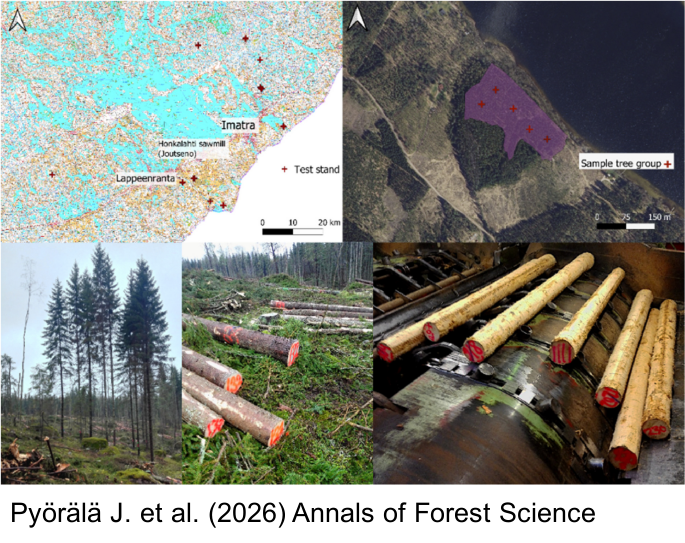 Key message
Using laser scanning and industrial data, we found that over 70% of wood quality variability occurred within Norway spruce (Picea abies H. Karst) trees. The most important wood quality predictors were stem size, crown vigor, and growth rate inferred from laser scans. Random Forest models based on the laser-scanned features captured 25% of the industrially measured wood quality variability with 39.9% RMSE on average. The low crown plasticity of Norway spruce introduced biological constraints to laser scanning-based wood quality modeling.
Keywords
Forest management; LiDAR; X-ray tomography; Data fusion; Random forest
Publication
Pyörälä, J., Pehkonen, M., Saikkonen, O. et al. From between-stand to within-tree variation: wood and timber quality of Norway spruce (Picea abies H. Karst) analyzed at scale using laser scanning and industrial data. Annals of Forest Science (2026). https://doi.org/10.1186/s13595-026-01326-w
Data availability
The point clouds used in this study are openly reposited in the Fairdata Etsin service:
– Pyörälä, J., Hyyppä, J., Kukko, A., & Kaartinen, H. (2026). Dense Airborne Laser Scanning point clouds from southeastern Finland (Version 1). University of Helsinki. https://doi.org/10.23729/fd-b7151c1a-6959-3fb3-af27-586f9ca415e6
– Pyörälä, J., Hyyppä, J., Kukko, A., & Kaartinen, H. (2026). Dense Handheld Laser Scanning point clouds from southeastern Finland (Version 1). University of Helsinki. https://doi.org/10.23729/fd-0a21c7cc-1df5-302d-927e-eacf72857f07
The rest of the research materials of this study are available from the corresponding author (JP), but restrictions apply to the availability of the industrial data, which were used under license for the current study and so are not publicly available due to proprietary reasons. The data are, however, available upon request and with permission from the Finnish Geospatial Research Institute (FGI).
Handling editor
Erwin Dreyer