Adaptive effects of geographic origin on ring-width and radial growth—climate relationships in Pinus nigra Arnold, the European black pine
Research paper
Key Message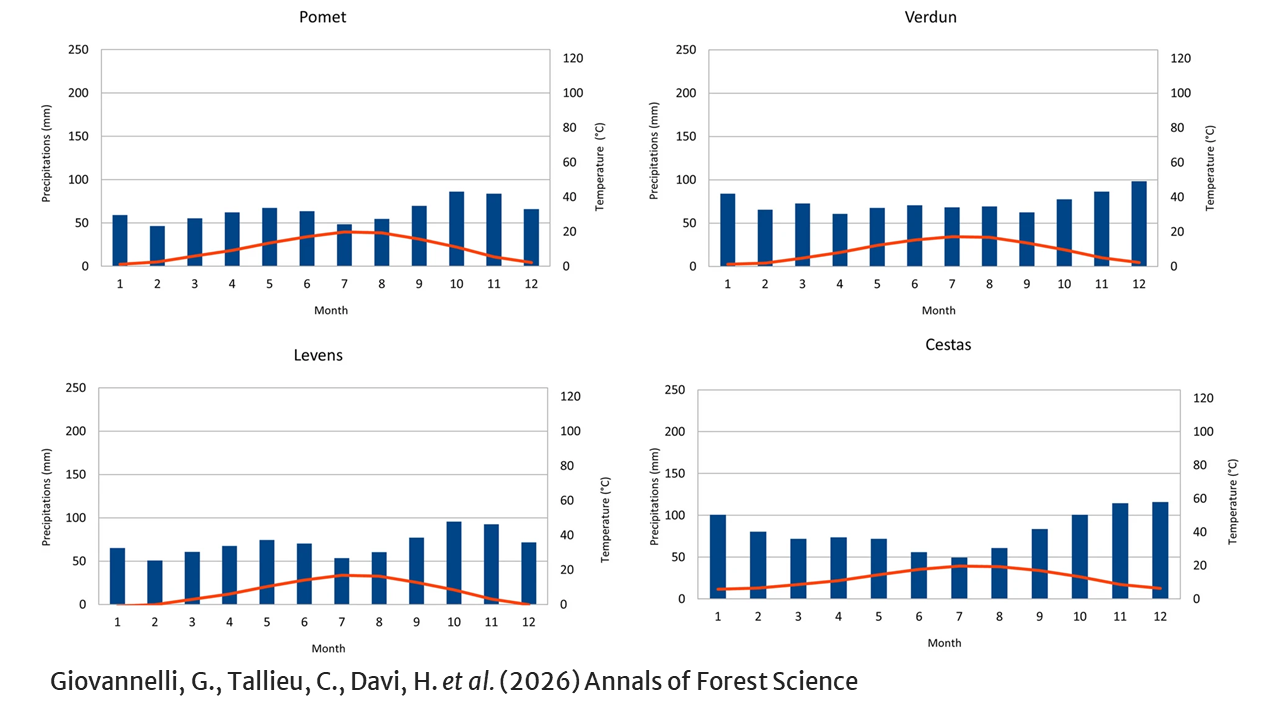
Radial growth is a fitness related trait that is expected to vary among forest tree populations when habitat conditions change. Yet, the genetic variability of ring-width and radial growth–climate relationships among geographic origins within species is rarely investigated. This is what we analyzed in the European black pine, Pinus nigra J.F. Arnold (1785), a forest tree species widely but patchily distributed. Using four partially replicated common gardens in France, we show that late spring minimum temperatures affect radial growth negatively and early summer precipitations positively across all provenances. In contrast, there was a strong provenance effect on mean ring-widths, as well as high phenotypic plasticity and significant genotype by environment interactions in most provenances and all subspecies. Provenances of the subspecies P.n. subsp. salzmannii often displayed the smallest mean ring widths except in the least fertile common garden. A few provenances of P.n. subsp. pallasiana, P.n. subsp. laricio and P.n. subsp. nigra performed equally well in all common gardens. Climate smart forestry should consider provenance and not just subspecies recommendations for plantations where black pine is not native, either for ecological restoration or timber production.
Keywords
Common garden; Genetic diversity; Phenotypic plasticity; Climate change; Dendroecology
Publication
Giovannelli, G., Tallieu, C., Davi, H. et al. Adaptive effects of geographic origin on ring-width and radial growth—climate relationships in Pinus nigra Arnold, the European black pine. Annals of Forest Science 83, 31 (2026). https://doi.org/10.1186/s13595-026-01347-5
Data availability
The data that support the findings of this study are available online: https://doi.org/10.57745/SKPSYI
Handling editor
Erwin Dreyer