Visual perception of different wood surfaces: an event-related potentials study
 Key message
Visual perception of the appearances of different wood surfaces is greatly influenced by their features, such as color, grain, and gloss. Among these features, human visual perception of wood grain type occurs through a later and higher-ordered cognitive process than the perception of color or gloss. Dark wood was subjectively preferred to light- or medium-colored wood, and both matte and glossy wood were preferred to semigloss wood.
Abstract
Context Understanding how the appearance of wood is processed in visual perception is critical for wood product design and will help improve consumer satisfaction. Unlike traditional subjective evaluation, neuroscientific methods enable a quantitative understanding of the process and are sensitive to the human visual perceptual response to the appearance of wood surfaces.
Aims The objectives of this study were to quantify the visual perception process and to explore the human neural activity elicited by different wood surface appearances.
Methods Three types of wood differing in color (light, medium, and dark) were cut to expose two different grain types (radial and tangential) and finished to three different gloss values (matte, semigloss, and glossy); digital images of these stimuli were shown to the subjects on a screen. A subjective emotion scale was constructed to measure their subjective evaluation, and neural ERP (event-related potential) data reflecting subjects’ early visual perception were recorded. Finally, all the data underwent analysis of variance as well as correlation analysis.
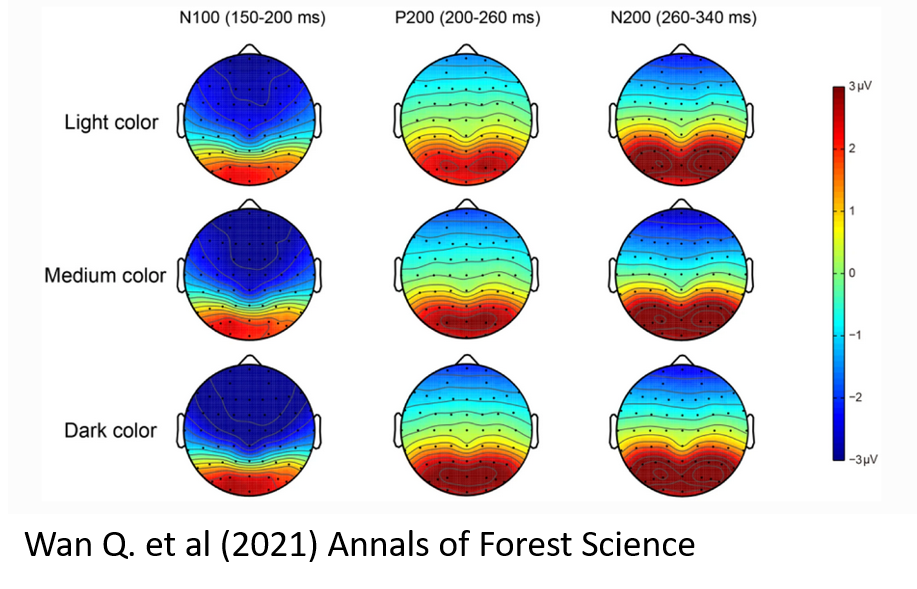
Results Regarding early visual perception, the measurements of relevant ERP components showed that subjects perceived the color and gloss of wood more quickly than the grain type, and their perception of wood grain involved a higher-order cognitive process. The match or mismatch between a given stimulus and a subject’s visual memory of wood surface appearance could enhance different ERP components, respectively. In addition, subjects had significantly greater appreciation for dark wood than for other colors, and semigloss wood was less favored than matte or glossy wood.
Conclusion This study provides an objective method to measure the visual perceptual processing of wood appearance; this method may help improve the efficiency of material selection for wood product design. Furthermore, the quantification method can be used by designers in measuring their wood products, and the results can be treated as indicators by which to evaluate the appearance of wood.
Keywords
Wood surface appearance; Visual perception; Neuroscience; Event-related potentials
Publication
Wan, Q., Li, X., Zhang, Y. et al. Visual perception of different wood surfaces: an event-related potentials study. Annals of Forest Science 78, 25 (2021). https://doi.org/10.1007/s13595-021-01026-7
For the read-only version of the full text:
https://rdcu.be/chizD
Data availability
All the datasets generated during and/or analyzed the current study are available in the Figshare repository: https://doi.org/10.6084/m9.figshare.9777506.v1
Handling Editor
Jean-Michel Leban