Assessing management factors limiting rice production in Venezuela

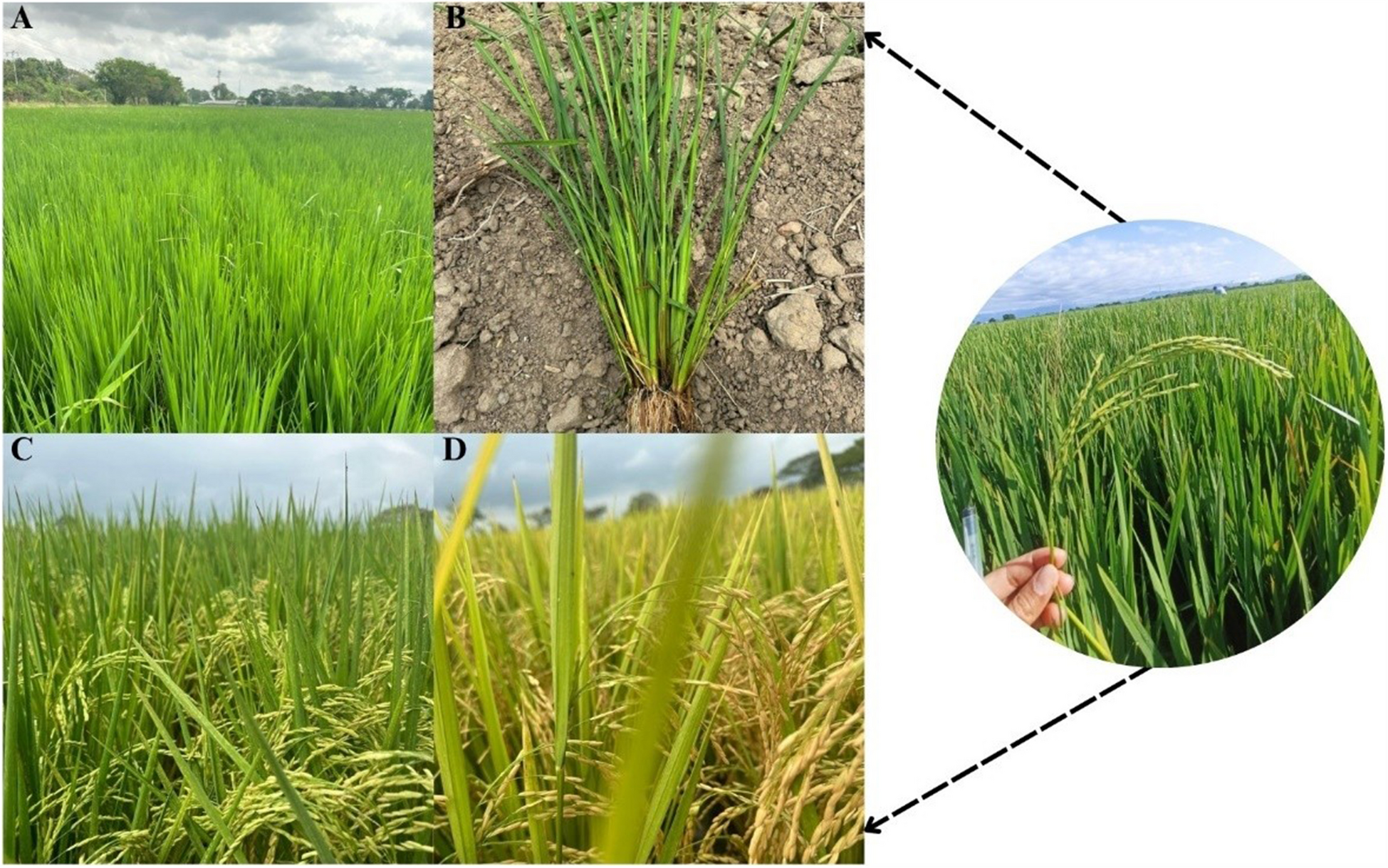
Field visits for monitoring and data collection in irrigated rice farms in Venezuela under the Pilot Project ST 52 of the United Nations Industrial Development Organization (UNIDO). A, B Crop and plants during the vegetative phase. C, D Crop and plants during the reproductive phase. Photos credits: Tarmar Lopez.

Rice once played a strategic role for food security in Venezuela, but economic stagnation and the onset of hyperinflation in 2016 led to a sharp decline in production. Today, the country imports about 45% of its rice needs. Despite this critical situation, no previous studies have quantified rice yield potential or yield gap analyses in Venezuela, leaving an important research gap regarding the country’s capacity to achieve self-sufficiency. The objectives of this study were threefold: (i) to determine the rice yield potential and yield gap for the wet and dry seasons, (ii) to identify the biophysical and management factors causing the yield gap, and (iii) to estimate whether it is possible to achieve rice self-sufficiency by closing the yield gap in Venezuela. Yield potential was estimated using the Oryza v3 simulation model, and yield gaps were analyzed based on 401 farmer field surveys conducted over seven agricultural years (2018–2024). Additional production potential was assessed under scenarios of agricultural intensification and cropland expansion and compared with projections of rice demand until 2040. Results showed that the yield potential of irrigated rice ranged between 8.1 and 9.8 Mg ha−1 in the wet season and between 10.4 and 10.9 Mg ha−1 in the dry season. Yield gaps averaged 53% in the wet season and 59% in the dry season, with main constraints related to crop establishment methods and preceding summer crops. These findings highlight substantial opportunities to increase national production through improved agronomic practices. The novelty of this study lies in providing the first comprehensive and data-based assessment of rice yield gaps in Venezuela, combining crop modeling, farm surveys, and future demand scenarios. The results demonstrate that by intensifying rice-based systems and investing in research, rural credit, and infrastructure, Venezuela could achieve self-sufficiency and double domestic rice production by 2040.

de Souza, J.V.S., Pegoraro, C.P., Soares, C.F. et al. Assessing management factors limiting rice production in Venezuela. Agron. Sustain. Dev. 45, 68 (2025). https://doi.org/10.1007/s13593-025-01068-5

Understand farmers’decision-making in peanut area allocation and management practices in a Sub-Sahelian region

Some typical scenes of peanut cultivation in the study area, from June to November 2018, at the Niakhar observatory (IRD), Senegal. a Peanut sowing, b weeding, c some components of the agroecosystem, d threshing operations, e winnowing to separate pods and fodder, f peanut transporting after harvest Photocredit: Sophie Djiba.

Peanut is a crucial cash crop across numerous West African countries, especially in Senegal, where small-scale family farms frequently rotate it with millet. Despite significant research on yield enhancement, the drivers behind farmers’ choices have been largely ignored. Recognizing that effective agricultural recommendations must be tailored to the specific context of individual farms, this study aimed for the first time, to understand the decision-making of peanut farmers in a typical rainfed region of the central-western Senegalese peanut basin. We surveyed 46 farmers, gathering data on their resources, perceptions, peanut area allocation, and management practices, as well as socio-economic outcomes. High-peanut farmers, with an average of 28% of their cultivated area allocated to peanut, had more resources than low-peanut farmers, which allocated only 3%. The former enhanced their peanut management by employing farm-saved seeds, hiring labor, and utilizing both manure and synthetic fertilizers. Their average peanut unshelled grain yield (625 kg ha−1) was the highest, although largely under the achievable yield. Their return on investment, which included the value of their own consumption, was also the highest (974%). Medium-peanut farmers presented intermediate characteristics. A widespread high level of self-consumption and investment in watermelon as a new cash crop suggested weak market opportunities for peanut. Low-peanut farmers identified lack of equipment and finance as major constraints, while high-peanut farmers cited lack of finance and quality seeds. All categories recognized peanut’s ecological advantages. These results highlight that limited peanut cultivation and unsustainable practices do not stem from farmers lacking technical knowledge or undervaluing peanut advantages but rather from the socio-economic constraints they face. Solutions for high-peanut farmers may not suit or be adopted by low-peanut farmers. Addressing this disparity requires multi-faceted research and innovations targeting both external and internal farm constraints, shifting from mere inputs provision to co-designing innovations directly with farmers.

Djiba, S., Clermont-Dauphin, C., Tounkara, A. et al. Understand farmers’decision-making in peanut area allocation and management practices in a Sub-Sahelian region. Agron. Sustain. Dev. 45, 40 (2025). https://doi.org/10.1007/s13593-025-01032-3

Agroecological principles and elements for sustainable food systems

Picture copyright Jerzy Górecki

Persistent malnutrition and rural poverty, environmental degradation, and loss of biodiversity are global challenges for food systems, aggravated by the growing consequences of climate change. Agroecological principles, when applied in context, generate transition pathways that transform agricultural and food systems to address these issues. Scientists Wezel et al. identified among these principles, four key entry points for systems transformation: diversity, circular and solidarity economy, co-creation and sharing of knowledge, and responsible governance.

Microbes help alleviating zinc and iron deficiencies in dietary food grains

Picture copyright Singh & Prasanna

Microorganisms play important roles in increasing micronutrient bioavailability to plants. Scientists Singh and Prasanna review the various strategies employed for the biofortification of Zn and Fe in dietary food grains. They emphasize the important role of soil-plant-microbe interactions in improving crop productivity, soil fertility, and translocation of micronutrients in crop plants. They reckon it is imperative to better integrate such microbial inputs into crop management practices.

Plant breeding strategies for sustainable agriculture

Picture copyright Chatin, INRA

Plant breeders must strive to improve food security, food and seed sovereignty, social justice, biodiversity, ecosystem services and adaptation to climate change. Scientists Lammerts van Bueren et al. show that none of the current breeding orientations will achieve all these targets and make a plea for a new integrated orientation, called “systems-based breeding” capable of producing cultivars with significant ecological and societal resilience.

A call for deep change of food systems

Picture copyright Elaine Casap, Unsplash

International experts agree that agriculture and food systems must transform to achieve Sustainable Development Goals and the Paris Agreement. Scientists Caron et al. advocate for a renewed political paradigm in dealing with food systems issues, linking agriculture, values chains, consumption and diet, health, social, political and environmental concerns and climate change. While food security cannot be addressed only in terms of agricultural supply, they appeal for a “context-specific, multidimensional and integrated” deep four part transformation.

Mapping crop supply and demand to improve food security

Picture copyright Rainer Rillke

Spatial quantification and mapping of the supply and demand of crops is helpful to plan local agriculture and make decisions. Scientists Sahle et al. quantified and mapped in Ethiopia the supply and demand of kocho, an indigenous food cooked from the Enset crop. In order to ensure food security of local communities, planners and decision-makers may now use such information to improve crop production in areas where the current supply-demand is not balanced so as to improve Enset access to local market.

Insects as sustainable food and feed

Picture copyright Van Huis

Edible insects species are promoted worldwide as sustainable human food and animal feed. Scientists Van Huis and Oonincx compare the environmental consequences of harvesting insects from nature with insect farming. They review the environmental sustainability of insect farming compared to livestock production, emphasizing several major benefits, such as less land and water needs and low greenhouse gas emissions.

Zinc spraying on wheat is cheaper with pesticides

Picture copyright WANG et al.

Biofortification of staple crops with zinc is a strategy for overcoming human zinc deficiency. Agronomists Wang et al. calculated the cost of agronomic biofortification of wheat with zinc in China. Results show that the price is high when zinc is sprayed alone. Whereas the cost is cheaper, from US$ 41 to US$ 108, when zinc is combined with routine pesticide management to reduce labor cost.

GPS navigation for plant and food : bon appétit !

Picture copyright LUVISI

Major issues of food security such as the lack of food in developing countries, food wasting, and food contamination could be solved if food could be traced efficiently from production to dishes. A review of Luvisi shows how development of radio frequency identification solutions  and sensors are improving automated systems in agriculture and the role of traceability in corporate food regime sustainability.