
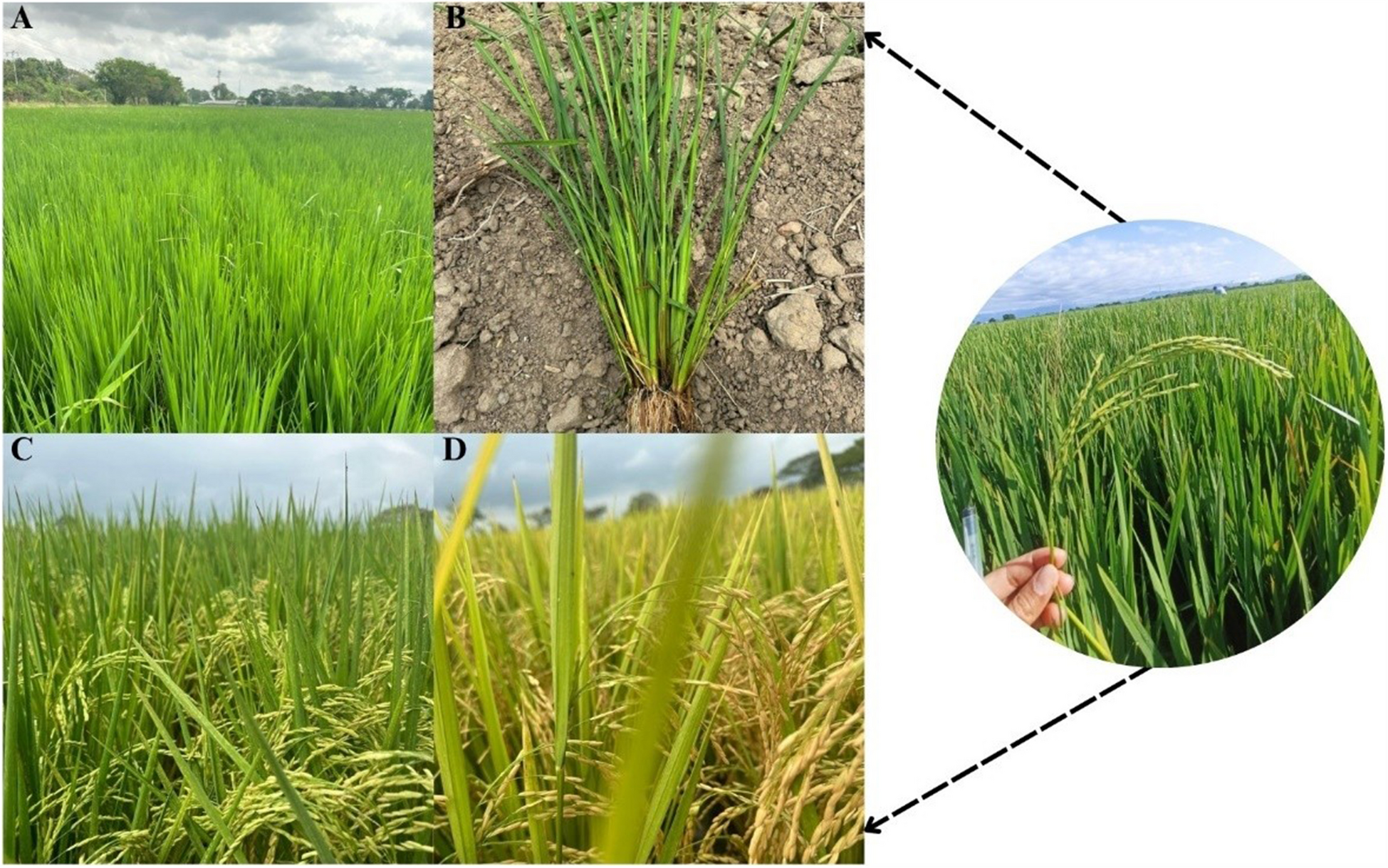
Rice once played a strategic role for food security in Venezuela, but economic stagnation and the onset of hyperinflation in 2016 led to a sharp decline in production. Today, the country imports about 45% of its rice needs. Despite this critical situation, no previous studies have quantified rice yield potential or yield gap analyses in Venezuela, leaving an important research gap regarding the country’s capacity to achieve self-sufficiency. The objectives of this study were threefold: (i) to determine the rice yield potential and yield gap for the wet and dry seasons, (ii) to identify the biophysical and management factors causing the yield gap, and (iii) to estimate whether it is possible to achieve rice self-sufficiency by closing the yield gap in Venezuela. Yield potential was estimated using the Oryza v3 simulation model, and yield gaps were analyzed based on 401 farmer field surveys conducted over seven agricultural years (2018–2024). Additional production potential was assessed under scenarios of agricultural intensification and cropland expansion and compared with projections of rice demand until 2040. Results showed that the yield potential of irrigated rice ranged between 8.1 and 9.8 Mg ha−1 in the wet season and between 10.4 and 10.9 Mg ha−1 in the dry season. Yield gaps averaged 53% in the wet season and 59% in the dry season, with main constraints related to crop establishment methods and preceding summer crops. These findings highlight substantial opportunities to increase national production through improved agronomic practices. The novelty of this study lies in providing the first comprehensive and data-based assessment of rice yield gaps in Venezuela, combining crop modeling, farm surveys, and future demand scenarios. The results demonstrate that by intensifying rice-based systems and investing in research, rural credit, and infrastructure, Venezuela could achieve self-sufficiency and double domestic rice production by 2040.
de Souza, J.V.S., Pegoraro, C.P., Soares, C.F. et al. Assessing management factors limiting rice production in Venezuela. Agron. Sustain. Dev. 45, 68 (2025). https://doi.org/10.1007/s13593-025-01068-5