
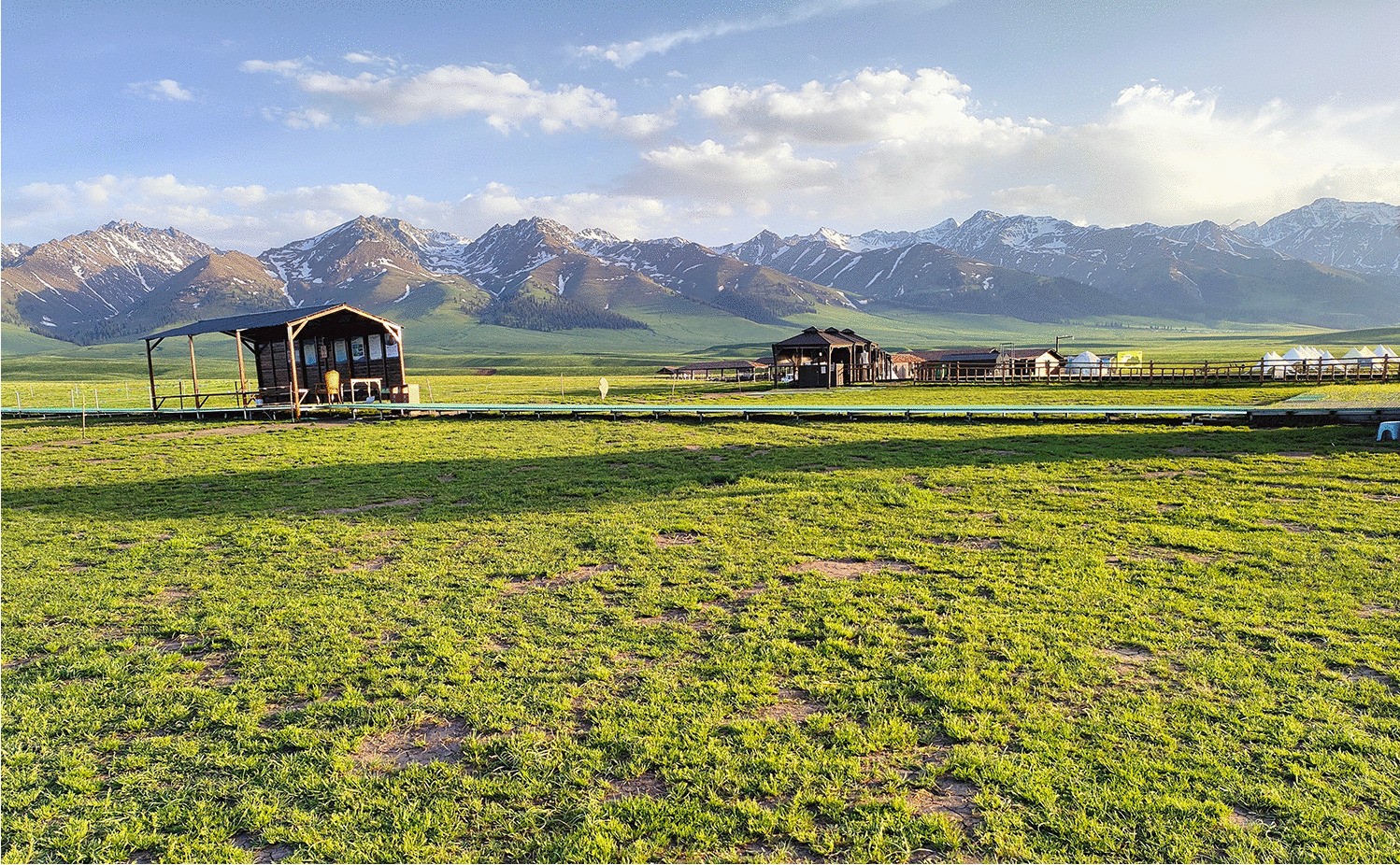
Rapid shifts in land-use policies and environmental conditions have made overgrazing a significant challenge to the sustainability of China’s fragile drylands, particularly the Tien-Shan montane grasslands. However, our understanding of the extent to which rangeland degradation is linked to the livelihoods of individual pastoralists adapting to these changes remains limited, especially in the context of the increasing intersection between subsistence pastoralism and tourism development. To evaluate the proposition that “smaller pastures lead to better tourism and less overgrazing”, we conducted a survey of 30 pastoral households managing small (<33 ha), medium, and large (>53 ha) pastures across two villages in the western Tien-Shan mountains, where tourism is on the rise and grassland degradation is evident. Our findings indicate that over the past two decades, the grassland vegetation in the studied area has undergone homogenization, degradation, and fragmentation. Households with small pastures tended to maintain higher livestock densities to support tourism infrastructure, which in turn intensified overgrazing. In contrast, large-pasture households relied on traditional grazing regimes, which resulted in lower levels of overgrazing but generated less income from tourism. Medium-pasture households attempted to cultivate forage grasses to balance both livelihoods, albeit with limited success. Despite these differing strategies, all groups achieved comparable annual incomes. This creates a paradox where increased tourism revenue in small pastures correlates with intensified overgrazing. Our study is the first to highlight that the coexistence of tourism and pastoralism poses critical challenges for grassland sustainability, particularly when smallholders are compelled to fragment pastures for tourism purposes. We argue that achieving a balance between these livelihoods in fragile ecosystems necessitates collaborative management approaches that integrate traditional pastoral practices with equitable tourism planning.
Zhao, D., Bayaerta, Liu, Z. et al. When tourism meets pastoralism: smallholder livelihood dilemmas and overgrazing in the fragile Tien-Shan montane grasslands. Agron. Sustain. Dev. 45, 62 (2025). https://doi.org/10.1007/s13593-025-01064-9

